Keeping a Commercial Lot Clean and Clearly Marked
Customers judge a property before they reach the door, and a clean, clearly marked lot tells them someone is paying attention.
October 21, 2026 · 4 min read
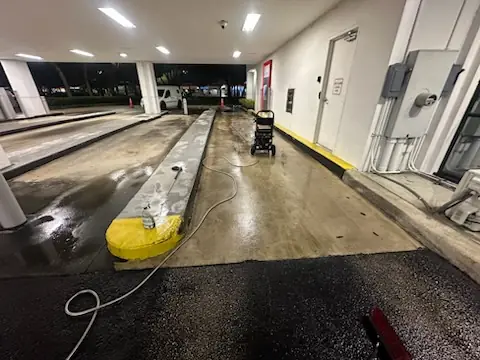
A commercial property is never finished. Cars, carts, delivery trucks and thousands of footsteps wear on every surface, and South Florida's sun and rain speed it along. For a property manager, the challenge isn't just keeping everything clean. It's keeping it clean and clearly marked without closing the business to do it. This post walks through the areas that wear first and how the work gets scheduled.
Where a lot shows wear first
The busiest areas go first: the drive-thru lane where cars idle and drip, the entrance walkway everyone crosses, the pavers outside the main door, and the curbs that take tire scuffs every day. Indoors, store floors and carpet in hallways and offices pick up the same traffic pattern. Wheel stops in parking rows get kicked, backed into and splashed by sprinklers, so they're often the first painted detail to look shabby. These are also the places customers notice most, because they're the first and last things they see.
Appearance is only part of it. Oil on a drive-thru lane, algae on pavers and worn paint on curbs all affect safety. Slippery surfaces cause falls, and faded markings leave drivers and pedestrians guessing where the edge is.
What a property manager can schedule
Most routine upkeep can be planned in advance, in sections, and on a repeating rhythm. A manager can break the property into zones and work through them instead of facing one big job. Common items include:
- Pressure washing of drive-thru lanes, entrances and paver walkways.
- Cleaning of store tile and hard floors, including grout lines.
- Carpet cleaning in offices, training rooms and hallways.
- Repainting of curbs, bollards, wheel stops and ramp edges.
- Repair of cracked or lifted concrete at entrances and walkways.
- A walk-through after the work to confirm every zone is done.
Grouping these into a single visit, or a short run of visits, saves coordination time. It also means the property looks consistent, instead of one clean area beside one tired one. Ask for a written list of zones so nothing gets skipped, and check each one off together at the end.
Working around business hours
Timing is where most commercial work is won or lost. A drive-thru lane can't be washed while cars are queuing through it, and a store floor can't be cleaned during the lunch rush. The usual answer is to work before opening, after closing, or on a slow day, and to do it in sections so part of the property stays usable. Wet surfaces need cones or signs, and paint needs the area closed off until it dries.
It helps to agree on this ahead of time. A short conversation about hours, access, deliveries and which areas are most sensitive makes the work smoother for everyone. The crew should arrive when expected, work efficiently and leave the area tidy, so staff and customers barely notice they were there.
Floors, tile and carpet inside
Inside the building, the same thinking applies. Convenience-store tile collects grime in grout lines and around entrances, and a floor that's been cleaned properly looks noticeably brighter. Office carpet in hallways and meeting rooms picks up traffic lanes and stains that vacuuming alone doesn't remove. Scheduling this after hours or on a quiet day keeps the space open for the people who use it.
The safety-yellow edge
Few details do as much work for as little effort as a freshly painted curb or bollard. Safety yellow is a signal: it tells drivers where the edge is, where a post stands, and where a ramp begins and ends. When that yellow fades to a dull beige or disappears under tire marks, the signal weakens. Wheel stops, entrance ramp edges and bollards near doors and fuel areas all benefit from a clean, bright finish.
The work is simple but the order matters: clean the surface, let it dry, paint it, and keep traffic off until it's set. Doing the washing first means the paint goes on a clean base and lasts longer. A property that gets its pavers, lanes and curbs done together ends up looking sharper than the sum of the parts.
A simple habit for managers
Walk the property once a month the way a customer would. Start at the street, cross the lot, enter the door and look at the floor. Note anything slippery, faded, lifted or stained. That short list becomes your work order.
WGG Services Facility LLC handles power washing, cleaning, painting and concrete work for commercial properties across South Florida and Miami-Dade. Estimates are free with no obligation. Call or text (786) 751-8469 and we'll plan the work around your hours.
WGG Services Facility LLC, (786) 751-8469
Call (786) 751-8469More articles
When to Pressure Wash Brick Pavers in South Florida
Brick pavers are tough, but the film that builds up on them in a humid climate makes them look tired long before they are.
What Happens Before the First Coat of Interior Paint
A smooth, even finish is mostly decided by the work nobody sees once the room is done.